
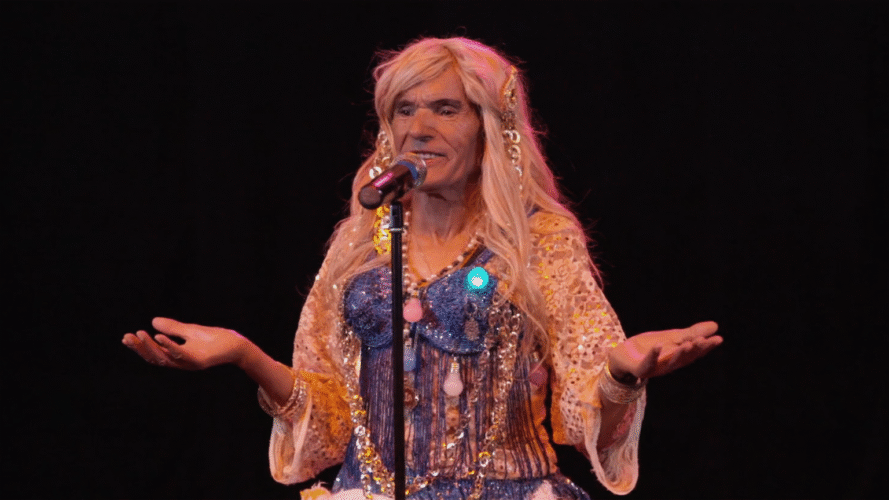
Ghazala, one of Tunisia’s longest-running drag entertainers, passes away, leaving an indelible mark on queer communities and local popular art.
On Wednesday, June 25, 2025, Tunisia bid farewell to one of the most prominent icons of popular queer art, the renowned drag artist and dancer Ghazala, who passed away at the age of 79.
The news of her death resonated widely among the queer communities in Tunisia and North Africa, with organizations and individuals across generations mourning her passing, considering her passing a profound artistic and human loss.
An Artistic Career of Defiance, Joy, and Light
Ghazala was born in the city of El Kef, northwest Tunisia, in 1946 and began dancing at the age of 12.
From her earliest days, she forged a unique artistic path based on drag entertainment, challenging the social and cultural constraints imposed on diverse gender expression.
Audiences knew her at weddings and other popular events, where she would enter in her colorful costumes and bright smile, spreading joy and redefining the concept of popular art.
According to a statement from the Tunisian Damj Association, Ghazala was known as “the gazelle of all joys,” walking the stage like a dream, with steps that carried enough light to remain present even after her departure. The statement added:
Ghazala departed, leaving an empty space on the stage she climbed, and the stage she was forbidden to climb. She is a permanent void in the hearts of those who loved her.
A Symbol of Resistance to Marginalization and Discrimination
Ghazala was not just an artist; she was also a symbol of resistance to marginalization, and one of the first physical voices to challenge gender norms in the Tunisian public sphere.
In an obituary published by Mawjoudin, the association noted that Ghazala was prevented from performing her final show due to her non-conformist gender expression, a fact that deeply affected her. The association stated:
Ghazala is a living example of what people without privileges experience in a society that is unforgiving of those who are different.
The Transgender Union of Tunisia also noted Ghazala’s importance as a rare queer artistic pillar, writing in its obituary:
Ghazala was not only a beacon on the stage, but she was the glow of stories and the joy of weddings. Her passing during the month of Pride is a farewell that places a responsibility on us to preserve our memory and cling to our unwritten history.
A Living Legacy in the Memory of Queers and El Kef
Despite years of oppression and silence, Ghazala was able to transform her body and her performance into a space for freedom and expression.
Her name is not written in official art books, but it is engraved in the memories of dozens of queer individuals, viewers, families who welcomed her to their weddings, and even those who saw her only once and never forgot her.
In the city of El Kef, where she appeared as a breeze of joy, freedom, and liberation passing between the houses, the laughter fades slightly today. The old corners fall silent, and the stage seems empty without her footsteps.
Farewell, Ghazala: A Body of Light and an Indelible Impact
Ghazala’s body is gone, but her voice, her laughter, her dress, her steps, and her dances remain present in the memories of entire generations of queer communities in Tunisia, North Africa, and the Middle East.
Her passing during International Pride Month is not a coincidence. It is a reminder of the history of queer people, often told in whispers or deliberately forgotten.
Today, Ghazala writes her end as she lived her life: on the bright margins that the state cannot see, but that no one can deny.
Farewell, Ghazala. You will remain an endless dance, an unquenchable light.